The problem
Onboarding lived across disconnected tools. Slack handled communication, Google Workspace held documents and records, and human memory connected everything in between. Each contractor created repeated manual steps, inconsistent follow-through, and business logic that existed only in people's heads. The client needed a system that non-technical HR operators could run and modify without a developer in the loop for every process change.
The engagement
This was an end-to-end delivery: requirements discovery with the client, solution design, iterative build, and operator handoff. The system had to fit an established organization's tools and permissions model rather than a greenfield stack. Every design choice accounted for the operators, workflows, and IT policies already in place.
The solution
I built a four-workflow n8n system that orchestrates Slack, Google Workspace, and Gmail, with human-in-the-loop steps wherever judgment matters. Four architectural decisions defined the build.
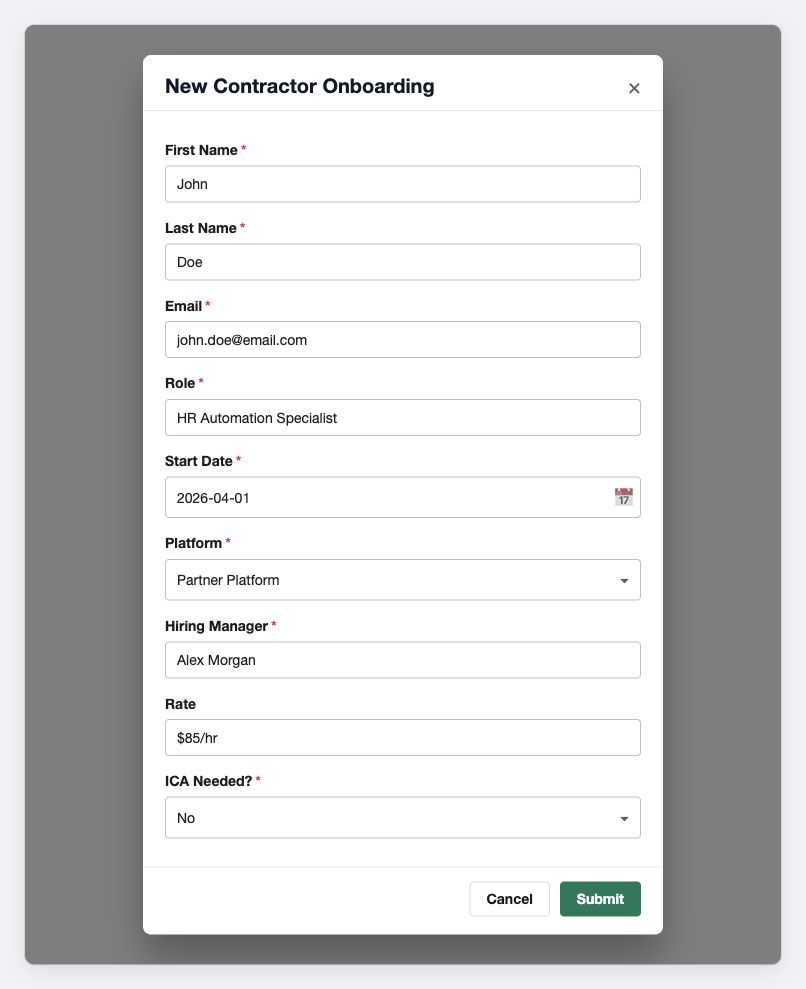
The Slack intake acknowledges the operator immediately, then hands the longer onboarding process to the background workflow. 1. Fire-and-forget architecture for Slack's 3-second SLA
Slack requires an acknowledgment within three seconds or the interaction fails. Long-running onboarding logic cannot live inside that window, so interactive triggers hand off immediately to sub-workflows through Execute Workflow calls. The operator gets an instant response while the heavier work continues asynchronously.
2. Multi-credential authentication without Domain-Wide Delegation
Instead of requesting broad, organization-wide Google Workspace delegation, the system uses scoped credentials for each service. This reduces the security surface, makes access easier to audit, and avoids depending on a Workspace administrator to approve sweeping permissions.
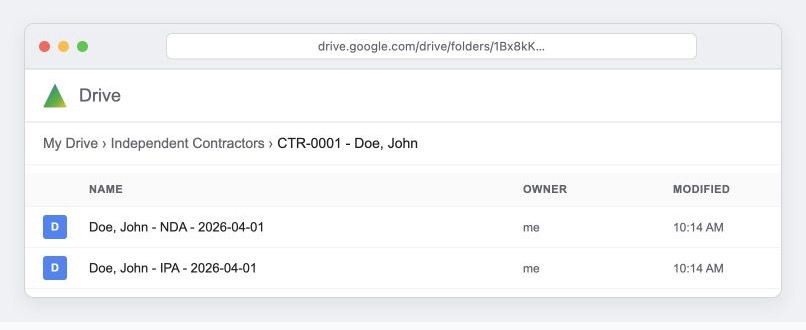
Scoped Google credentials create the contractor workspace and required documents without broad organization-wide delegation. 3. A Sheets-based configuration layer owned by HR
Onboarding rules, templates, and routing live in Google Sheets rather than being hardcoded into workflow nodes. HR can change notifications, documents, and sequencing without touching the workflow engine. The automation reads the configuration at runtime, so operators stay inside a tool they already know.
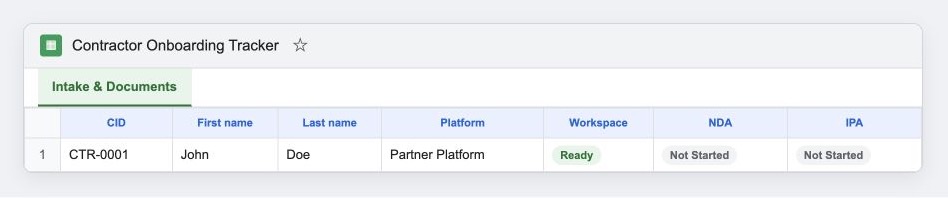
The live Sheets record keeps status and process data visible in a tool HR can inspect and maintain. 4. An initiator-owned accountability model
The person who starts an onboarding in Slack owns it through completion. HR, the hiring manager, and informed stakeholders enter the same loop at kickoff, so progress does not depend on email relays. Ownership transfers once, at the defined point when IT assigns credentials. There is always one owner and one clear next action.
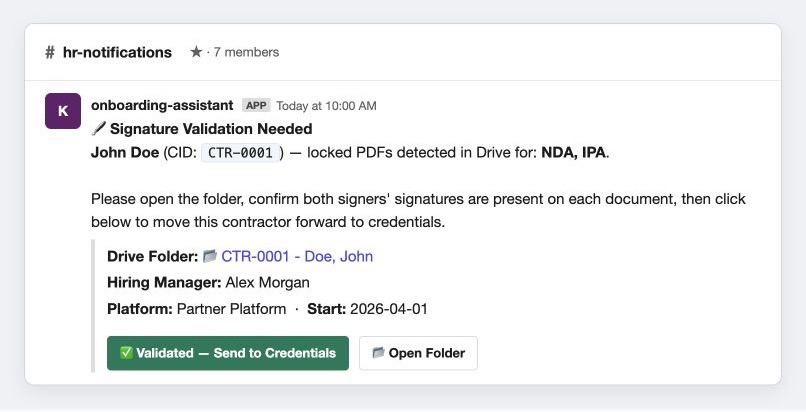
The responsible operator receives the validation request in Slack with the context and next action in one place.
Why it worked
The difficult engineering constraint was not connecting the tools. It was designing for the people who would inherit the system. Each architectural choice traded developer convenience for operator autonomy: asynchronous patterns keep the interface responsive, scoped credentials avoid broad administrative access, and a configuration layer turns process changes into spreadsheet edits instead of development requests. The result is a production system that survives its builder leaving the room. That was the actual deliverable.
Outcomes
- Manual coordination was removed from every onboarding cycle. Document distribution, notifications, record creation, and follow-up sequencing now run without a person driving them.
- Per-contractor work was reduced from a multi-step manual process to review-and-approve touchpoints, allowing HR to support headcount growth without matching growth in administration.
- Context switching was reduced for HR. Stakeholders enter the loop at kickoff, and the process stays where the work already happens instead of moving through email relays.
- Ownership is explicit. The Slack initiator remains responsible through completion, with one defined handoff when IT credential assignment is required.
- HR operators can modify business logic independently, without developer involvement.
Delivered from discovery through production handoff as an independent contractor.